Federal Prize Competitions 2026: Where to Find and Enter Them
Government prize competitions after challenge.gov: where federal challenges are listed in 2026, who can win cash, real prize examples and a concept-paper template.
Government prize competitions in the United States publish their prize amounts, eligibility rules and judging criteria openly, which makes them one of the most verifiable ways to earn a one-off cash prize from an idea. This 2026 guide uses only official pages to explain where federal prize competitions are listed now that challenge.gov has closed, who can win, and what you submit.
This guide covers only competitions where you submit an idea or concept paper once and winners are chosen by published criteria. It does not cover client work, freelance marketplaces, investing or gambling. No prize is guaranteed. Most entries do not win, and entries that do not win are not paid.
1. Where do you find federal prize competitions now that challenge.gov is gone?
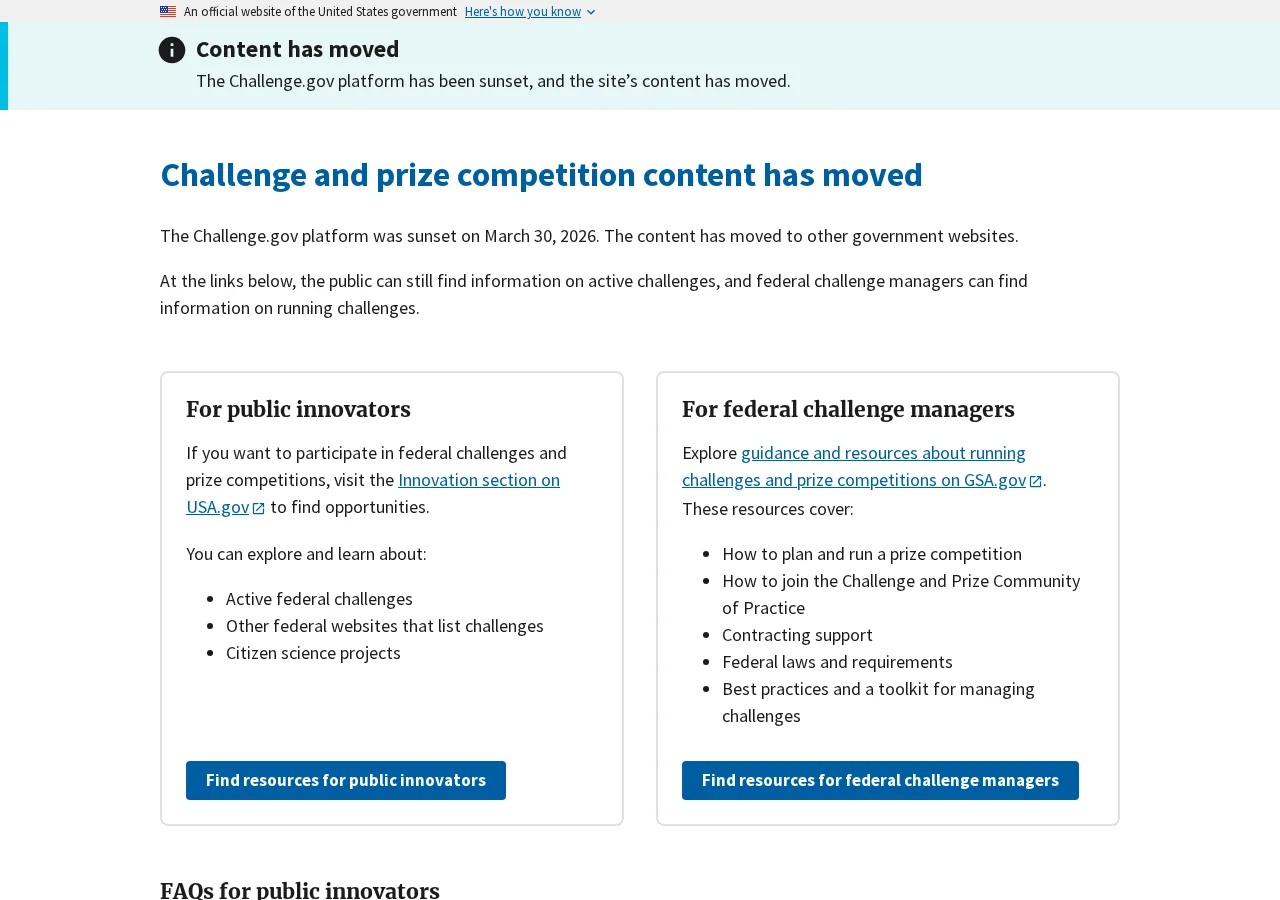
Challenge.gov states that the platform was sunset on March 30, 2026 and that information for participants moved to the Innovation section of USA.gov.
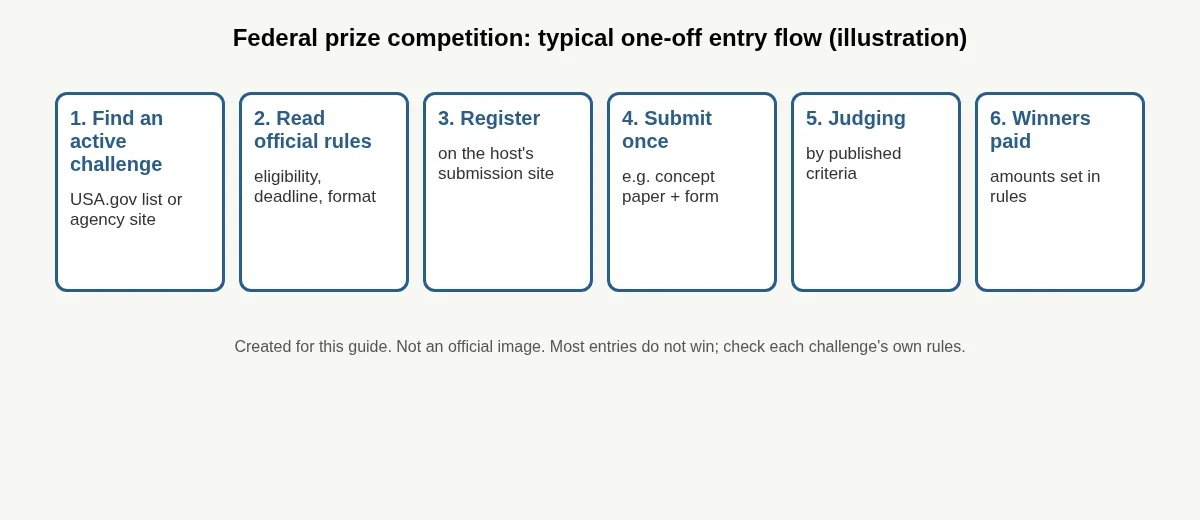
Start at the USA.gov "Challenges and prize competitions" page. From there you can open the list of active challenges, the how-to-participate page and a list of other agency sites.
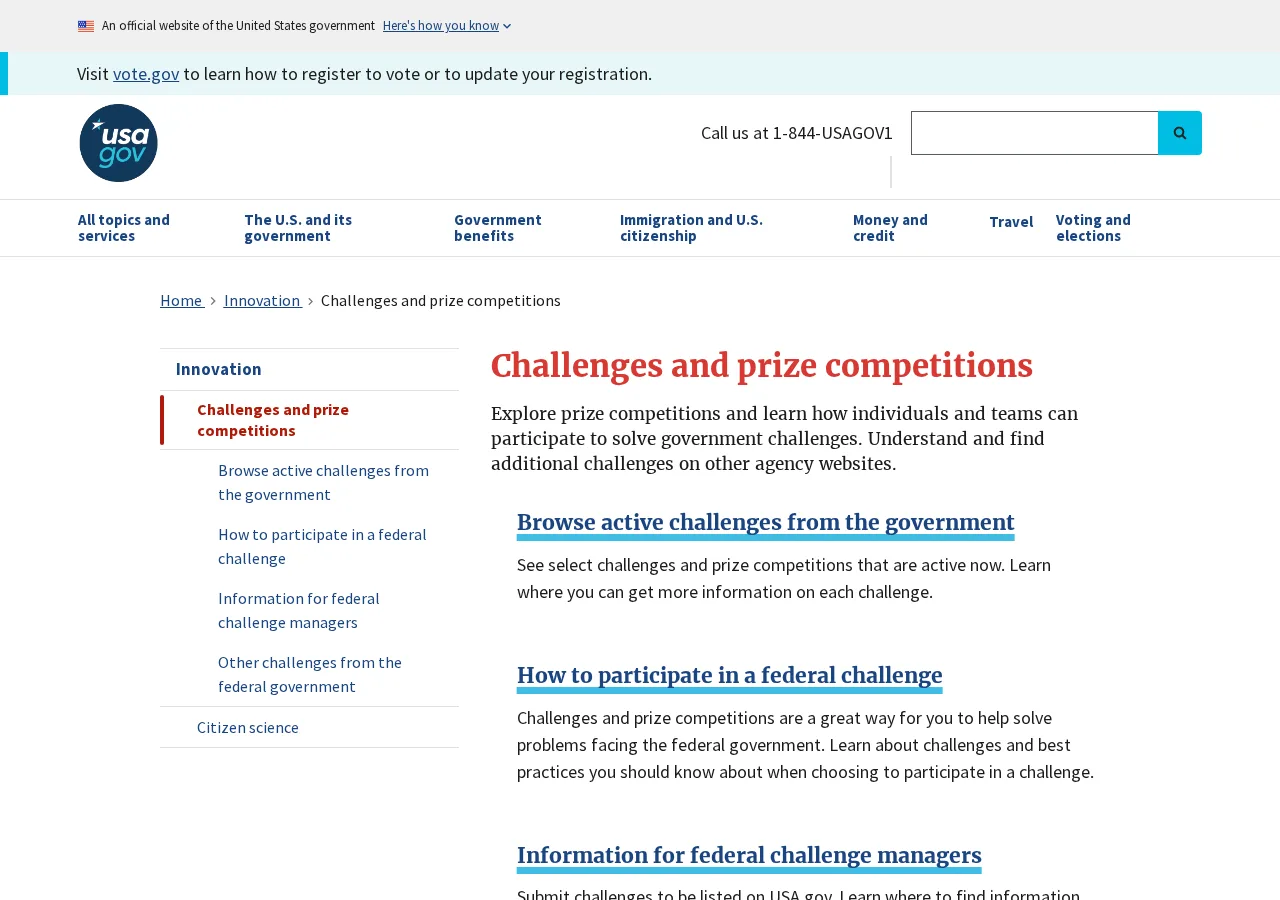
USA.gov says the U.S. government has run more than 1,600 prize competitions since 2010. Challenge types include data and analysis, creative design, business plan, idea, science, software, and technology and hardware.
2. Who can win a cash prize? (Check this first)
The law most federal challenges rely on (15 U.S.C. §3719, from the America COMPETES Act) says that to win a cash prize, an individual must be a U.S. citizen or permanent resident, and a private entity must be incorporated in and keep its primary place of business in the United States. Federal employees acting within the scope of their job are not eligible.
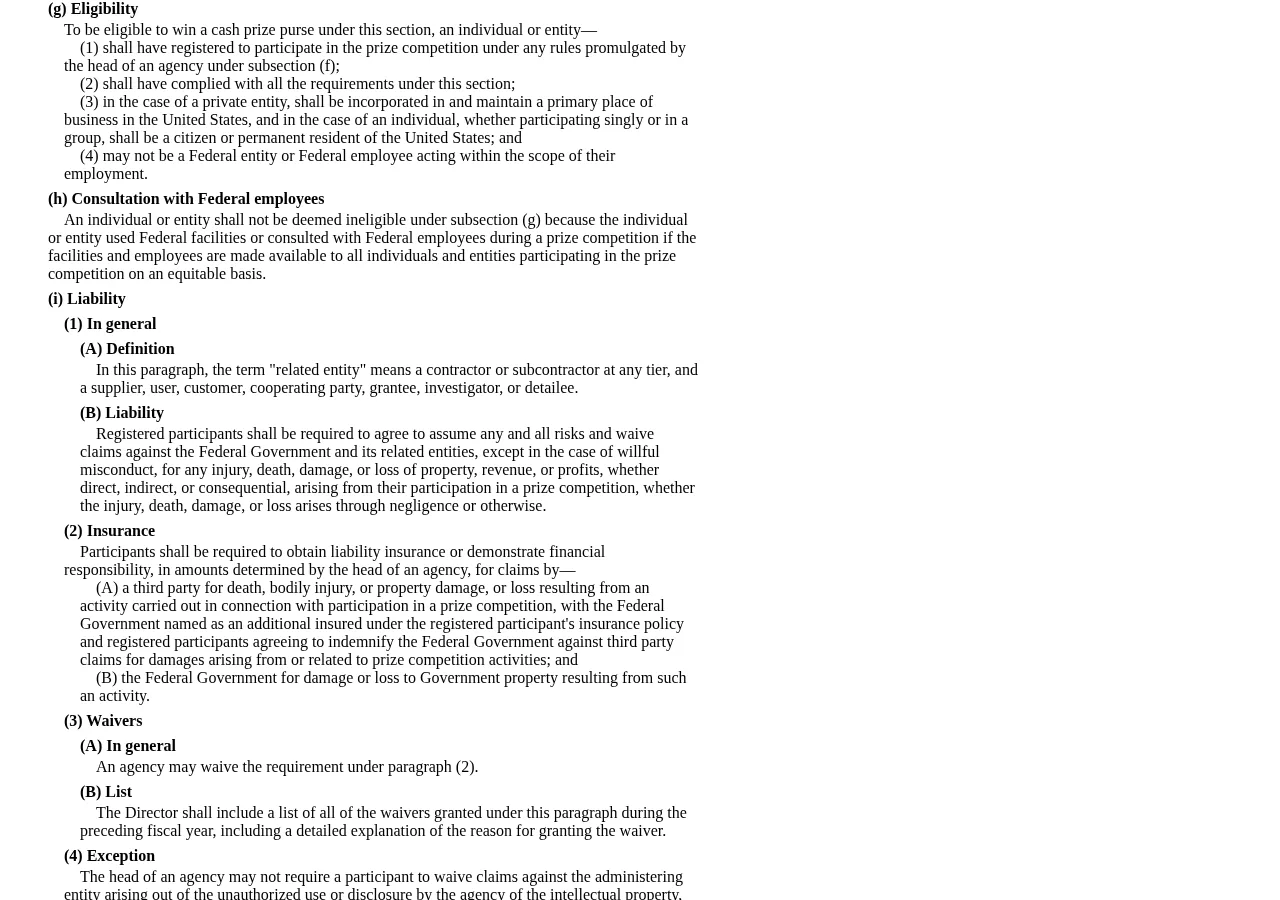
In practice, this route fits U.S. citizens, permanent residents and U.S.-based teams. Each challenge's own rules are the final word, so always read them.
3. Which challenges are on the official list right now? (Checked 2026-10-26)
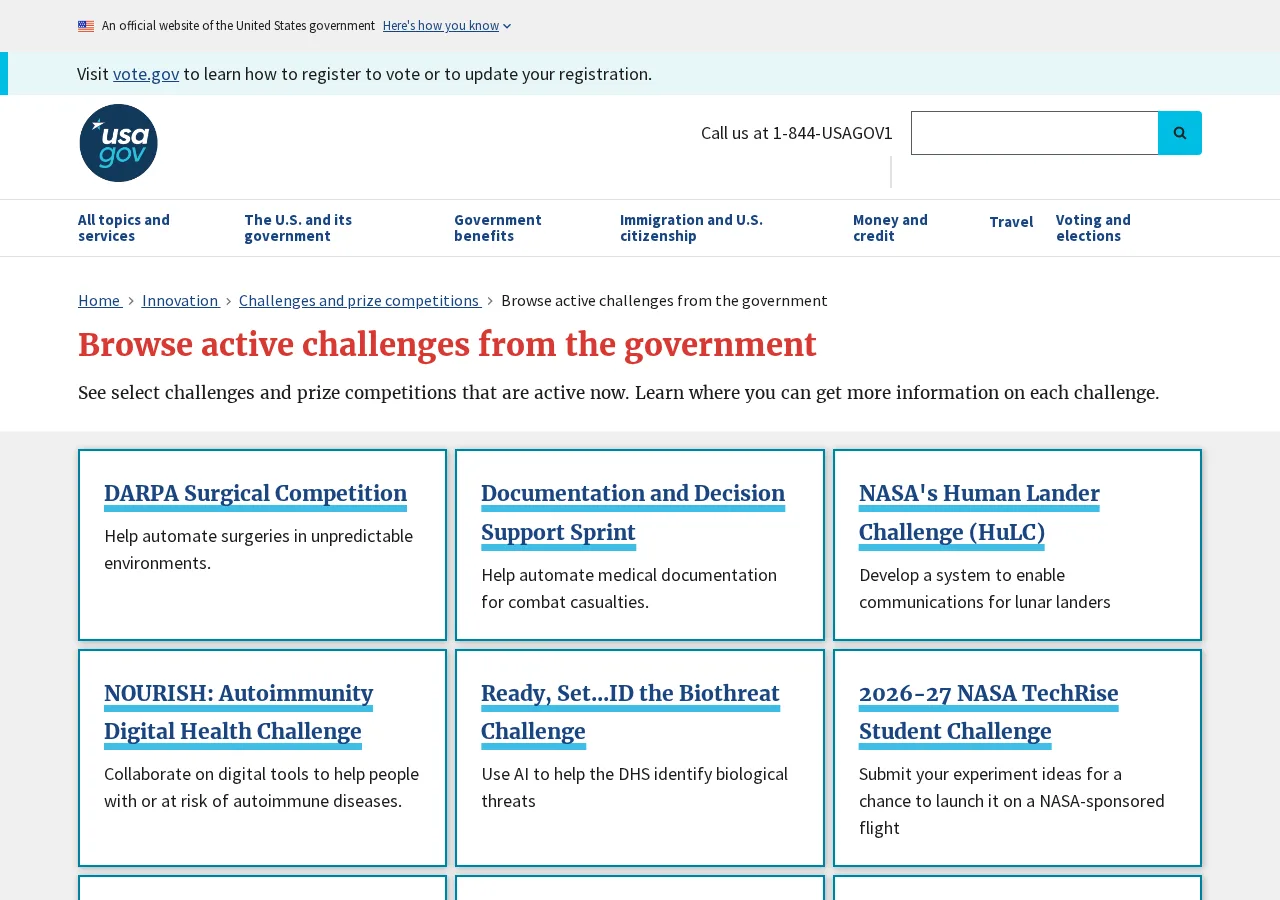
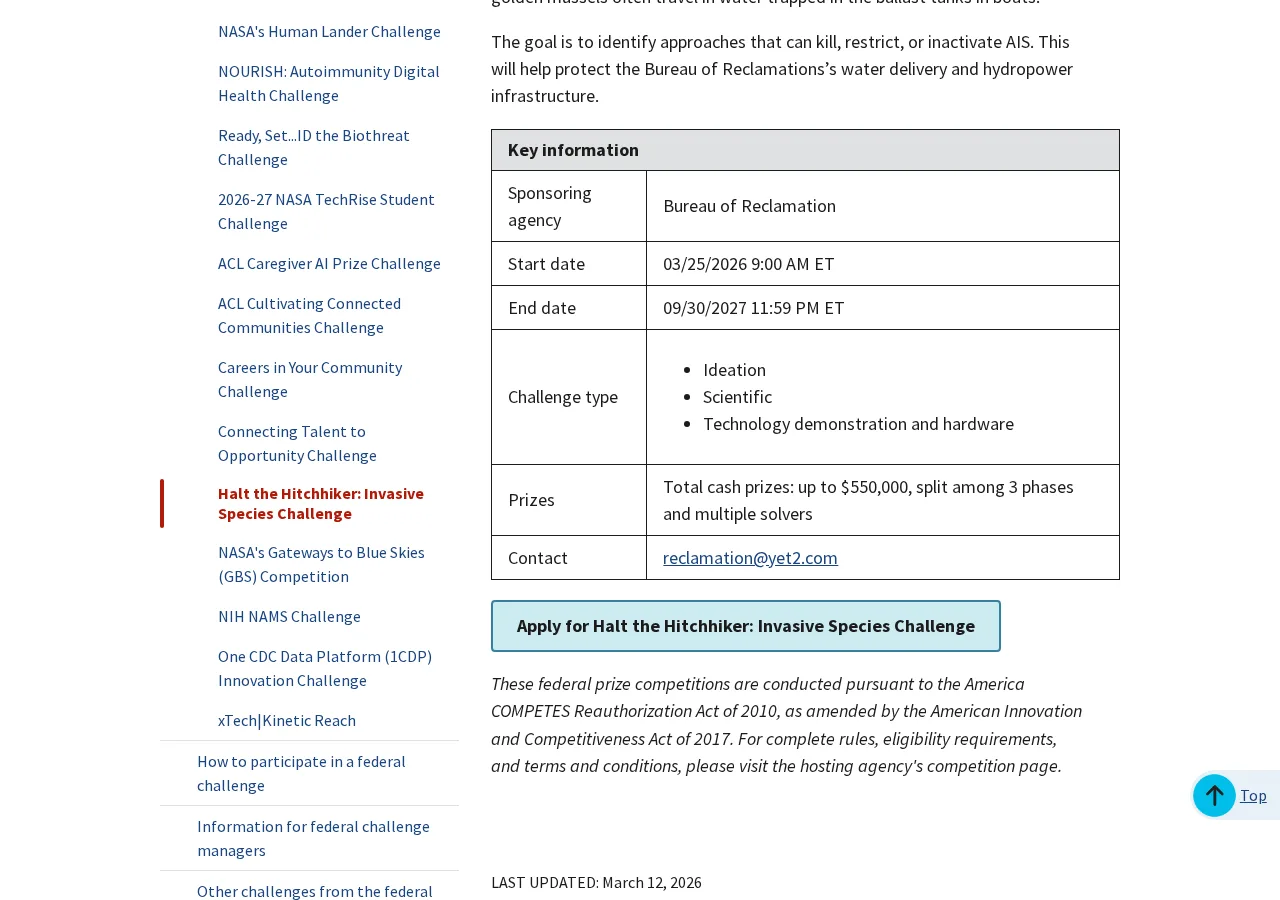
The USA.gov active list showed 15 challenges. Some are only for high school or college students, so filter by eligibility first.
| Challenge | Sponsor | Prizes per official page | Note |
|---|---|---|---|
| Halt the Hitchhiker: Invasive Species | Bureau of Reclamation | Up to $550,000 (≈ ₩770,000,000) total across 3 phases | Phase 1 (concept papers) is closed |
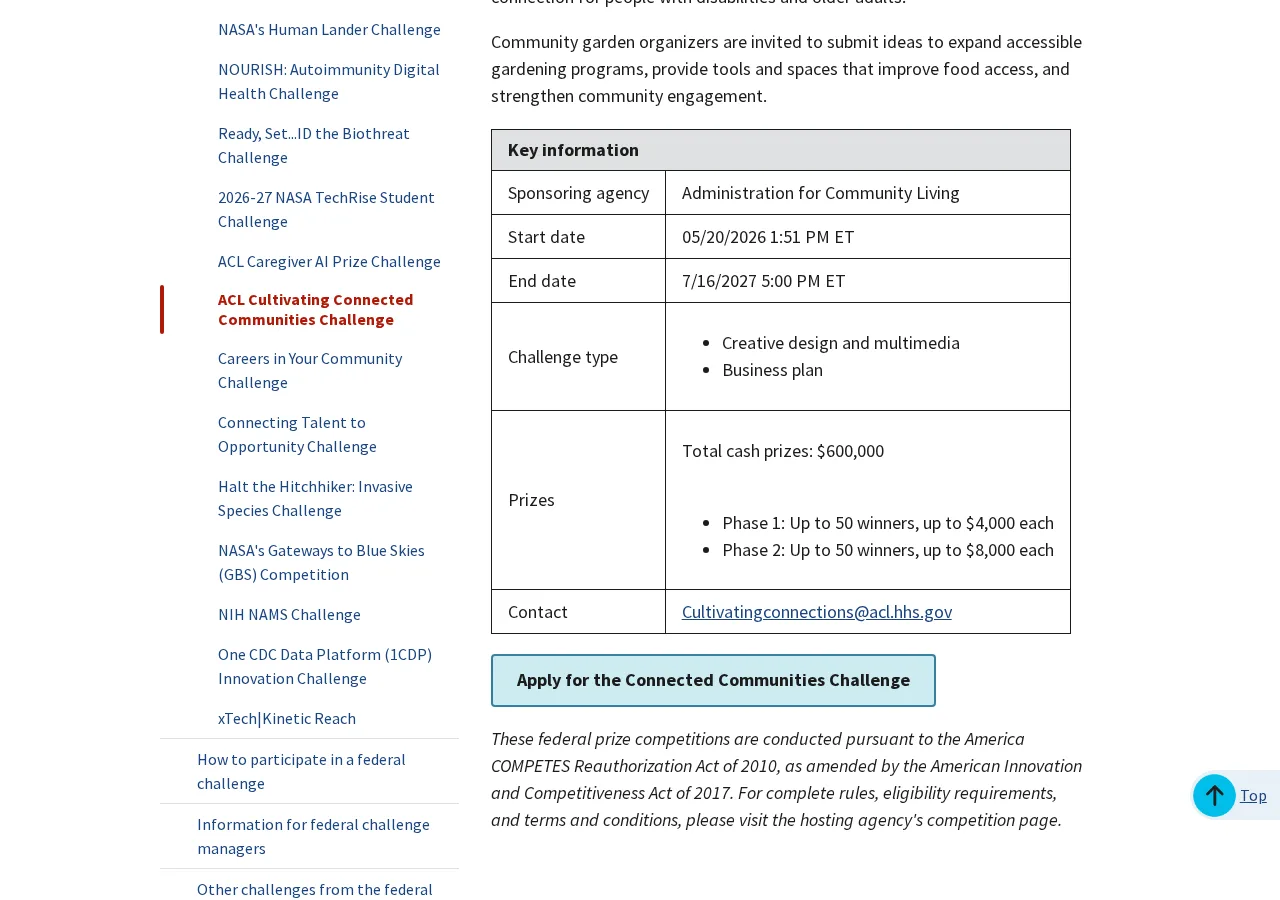
| Cultivating Connected Communities | Administration for Community Living (ACL) | $600,000 (≈ ₩840,000,000) total | For community garden organizers; Phase 1 winners announced |
| Gateways to Blue Skies | NASA | $72,000 (≈ ₩100,800,000) total; up to 8 finalist teams get $9,000 (≈ ₩12,600,000) each | College student teams of 2-6 only |
4. Realistic expectations
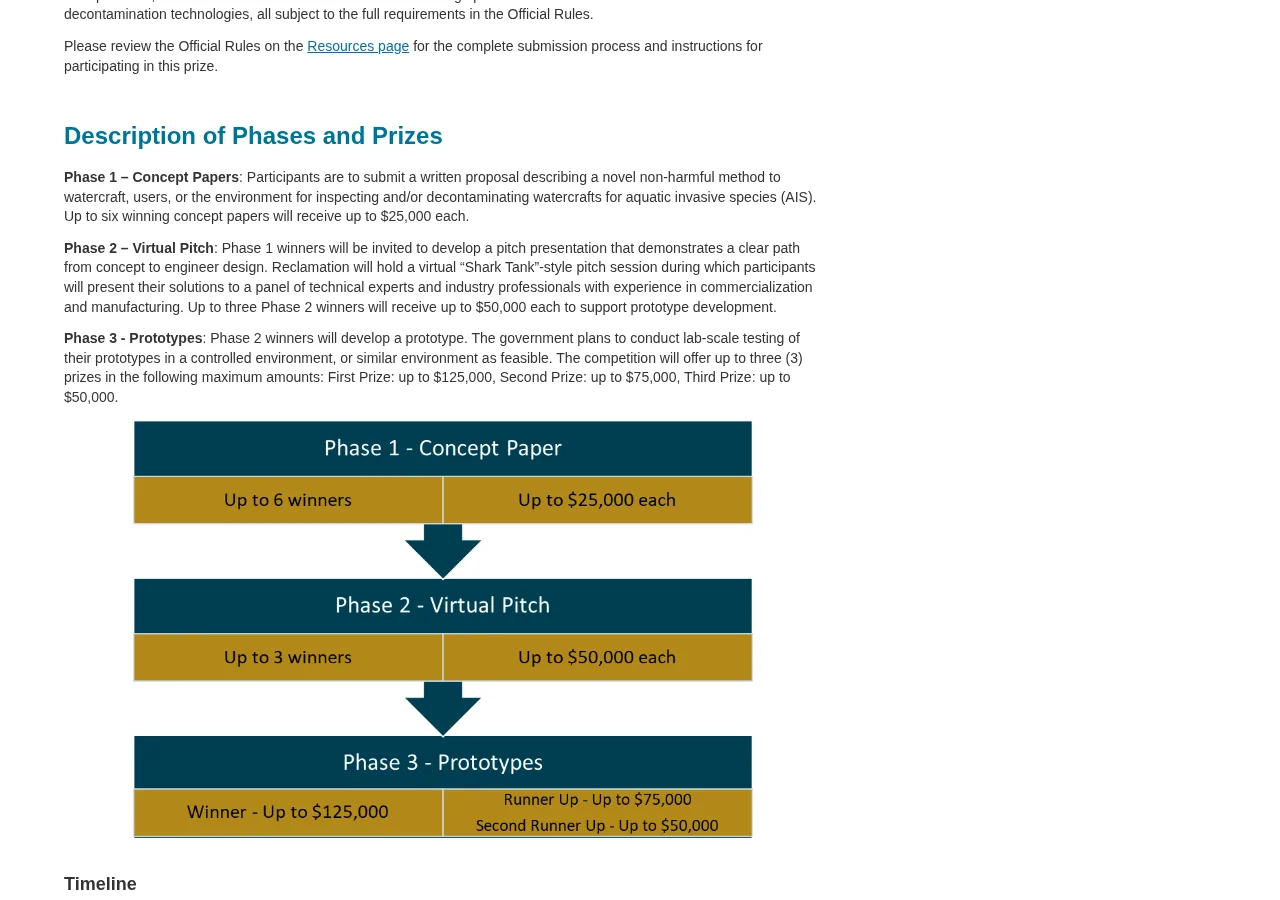
- Each challenge has few winners. Example: Halt the Hitchhiker Phase 1 allowed up to 6 papers at up to $25,000 (≈ ₩35,000,000) each.
- Many challenges run in phases. Phase 1 is often a single document; later phases are only for earlier winners, and they choose whether to continue.
- The law says the government may not gain an interest in a participant's intellectual property without written consent, but it may negotiate a license. Read the rights section of the rules.
- Taxes on prize money are not covered on the official pages checked here. Check this yourself.
5. Checklist before you start
- [ ] I meet the U.S. citizen / permanent resident (or U.S. entity) requirement
- [ ] I checked whether the challenge is student-only or team-only
- [ ] I confirmed the current phase is open and noted the deadline (U.S. Eastern Time)
- [ ] I downloaded the sponsor's Official Rules
- [ ] I checked the submission format and judging criteria
The paid part covers a real concept-paper structure and scoring weights, how to read phased prizes and timelines, finding more challenges on agency sites and the archive, rights and liability clauses, common mistakes and a final checklist.
FAQ
What are federal prize competitions?
They are challenges where U.S. government agencies ask the public for solutions and award prizes to the strongest entries. Agencies can run them under laws passed in 2010 and updated in 2017.
Is challenge.gov still working?
No. Challenge.gov was sunset on March 30, 2026. Active challenges are now listed on USA.gov and on agency websites such as HHS, DHS, NASA, NIH, the U.S. Army and USGS.
Can non-U.S. residents win government prize competitions?
Under 15 U.S.C. §3719, individuals must be U.S. citizens or permanent residents to win a cash prize. Some challenges may use other authorities, so check each challenge's rules.
Is there an entry fee?
The USA.gov pages and challenge pages checked for this guide did not mention entry fees. Confirm in each challenge's official rules.
Can I win just by submitting an idea?
Ideation challenges ask for a written idea or proposal. For example, Halt the Hitchhiker Phase 1 accepted only concept papers.
Related guides
- How to Win a Devpost Hackathon Prize
- Kaggle Competition Prizes: A Beginner Route
- Logo Design Contest Prizes
6. Step 1: Pick an active challenge
- Open the USA.gov page "Browse active challenges from the government".
- Read the one-line summary under each card title and open only those that match your skills (idea, design, software and so on).
- On each challenge page, read the "Key information" table: sponsoring agency, start and end dates (U.S. Eastern Time), challenge type, prizes and contact.
- The "Apply for ..." button below the table goes to the sponsor's or manager's site. USA.gov states that the complete rules and eligibility are on that site.
Watch out: a challenge can be on the USA.gov list while a phase is already closed. Halt the Hitchhiker shows an end date of 09/30/2027 on USA.gov, but its manager's page says Phase 1 submissions are closed. Always check the current phase on the manager's page.
7. Step 2: Five things to read in the official rules
USA.gov's participation page suggests checking:
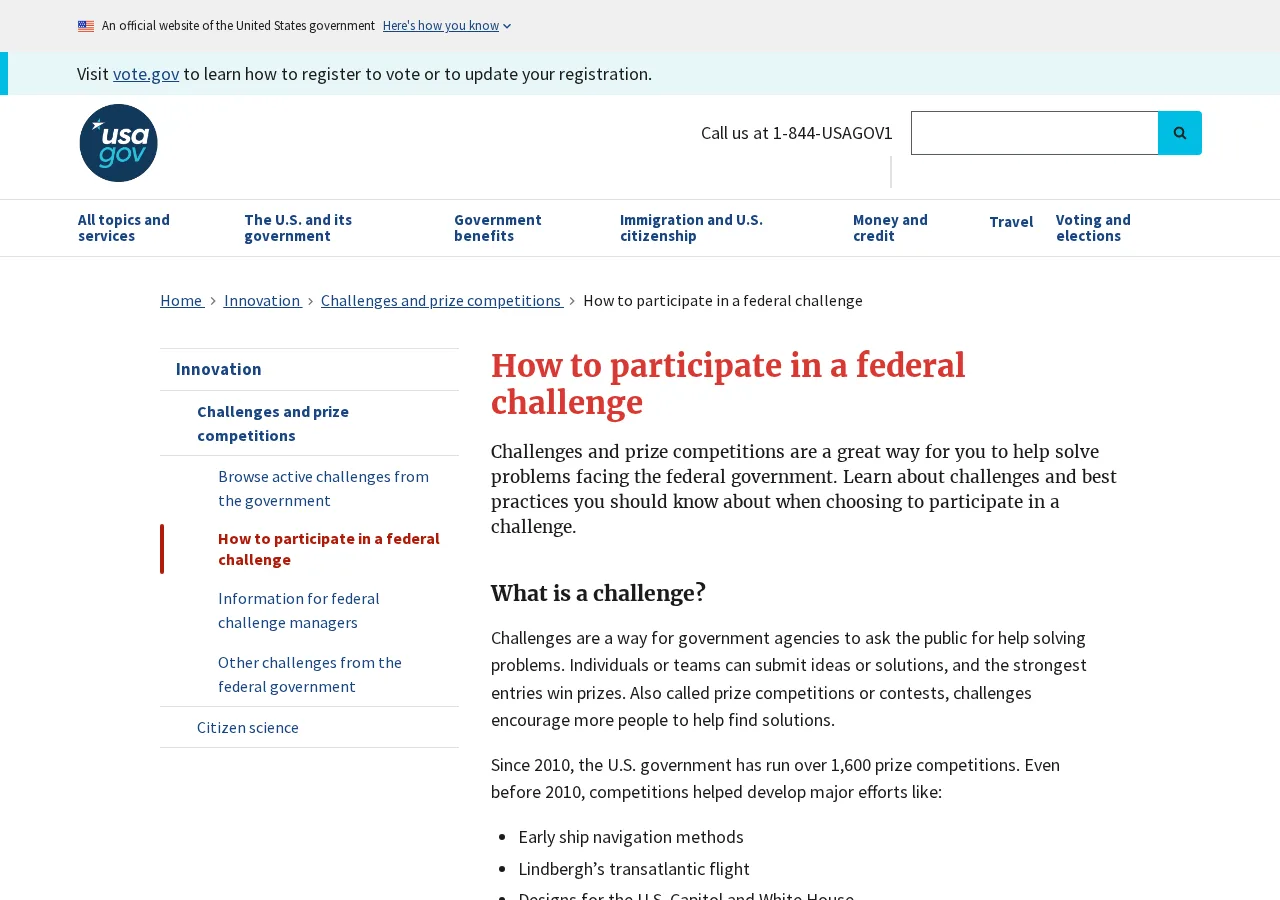
- Deadlines: start and end, and whether there are stages
- Submission: an idea only, or something you must build and show
- Prizes: cash or other rewards, one prize or smaller prizes along the way, prize categories
- Support: information sessions and points of contact
- Format: online, in person or mixed, and whether you present
The law (15 U.S.C. §3719(f)) requires agencies to publish the subject, eligibility rules, registration process, prize amount and the basis for choosing winners. If any of these is missing, ask the contact.
8. Step 3: Example submission structure (Halt the Hitchhiker Phase 1)
The manager's page (yet2) published these Phase 1 concept-paper guidelines. Entrants had to complete the online form and upload a Word or PDF file in Step 5 of the form.
| Section | Length |
|---|---|
| Abstract (may be made public) | Up to 1,000 characters |
| Technical description | 3-4 pages, about 6,000 characters + up to 5 images or charts |
| Commercial potential | 2-3 pages, about 3,000 characters + up to 3 images or charts |
| Development milestones | 2-3 pages, about 4,000 characters |
| Team and experience | 1-2 pages, about 2,000 characters |
Scoring: technical merit and feasibility 30%, practical viability and scalability 30%, concept maturity and readiness 30%, innovation and differentiation 10%.
A beginner-friendly writing order
- Use the judging criteria as your section headings.
- Under each heading, answer the listed judging questions one paragraph at a time.
- Put only public-safe content in the abstract (the page says it may be shown publicly).
- Count characters at the end to stay within limits.
9. How to read phased prizes and timelines
From the Halt the Hitchhiker official pages:
- Phase 1 concept papers: up to 6 winners, up to $25,000 (≈ ₩35,000,000) each. Due 29-May-26, winners announced 13-Aug-26, payment 28-Aug-26 (as listed by the manager)
- Phase 2 virtual pitch: Phase 1 winners only, up to 3 winners at up to $50,000 (≈ ₩70,000,000) each
- Phase 3 prototypes: first up to $125,000 (≈ ₩175,000,000), second up to $75,000 (≈ ₩105,000,000), third up to $50,000 (≈ ₩70,000,000)
For Cultivating Connected Communities (ACL), the USA.gov table lists $600,000 (≈ ₩840,000,000) total, Phase 1 up to 50 winners at up to $4,000 (≈ ₩5,600,000) each, and Phase 2 up to 50 winners at up to $8,000 (≈ ₩11,200,000) each. The ACL page announced 70 Phase 1 winners at $4,000 (≈ ₩5,600,000) each, with Phase 2 reports due May 26, 2027. The two pages differ, so treat the sponsor's page as primary.
"Up to" is a ceiling, not a promise of that amount.
10. Finding more challenges
- The USA.gov page "Other challenges from the federal government" points to challenges on HHS, DHS, NASA, NIH, U.S. Army and USGS sites.
- Challenges hosted before 2026 are archived in GSA's GitHub repository (GSA/challenges-and-prizes). Use it to study past rules and formats.
11. Rights and liability clauses
Under 15 U.S.C. §3719:
- The government may not gain an interest in your intellectual property without your written consent; it may negotiate a license.
- Participants must agree to assume risks and waive claims against the government (except willful misconduct).
- Agencies may require liability insurance or proof of financial responsibility, and may waive this.
- An agency may not announce a challenge until the prize funds are appropriated or committed in writing.
12. Common mistakes
- Applying to a student-only challenge (NASA Gateways to Blue Skies is for college teams of 2-6)
- Preparing for a phase that already closed because you only read the USA.gov end date
- Writing in a different order from the judging criteria
- Putting sensitive technical details in an abstract that may be published
- Misreading the deadline time zone
13. Final checklist
- [ ] Eligibility checked (citizenship or residency, student status, team size)
- [ ] Current open phase and deadline (with time zone) confirmed
- [ ] Full official rules read; rights, liability and tax clauses marked
- [ ] Submission follows the judging criteria order and length limits
- [ ] Contact email and webinar dates noted
- [ ] Submission confirmation screen or email saved